
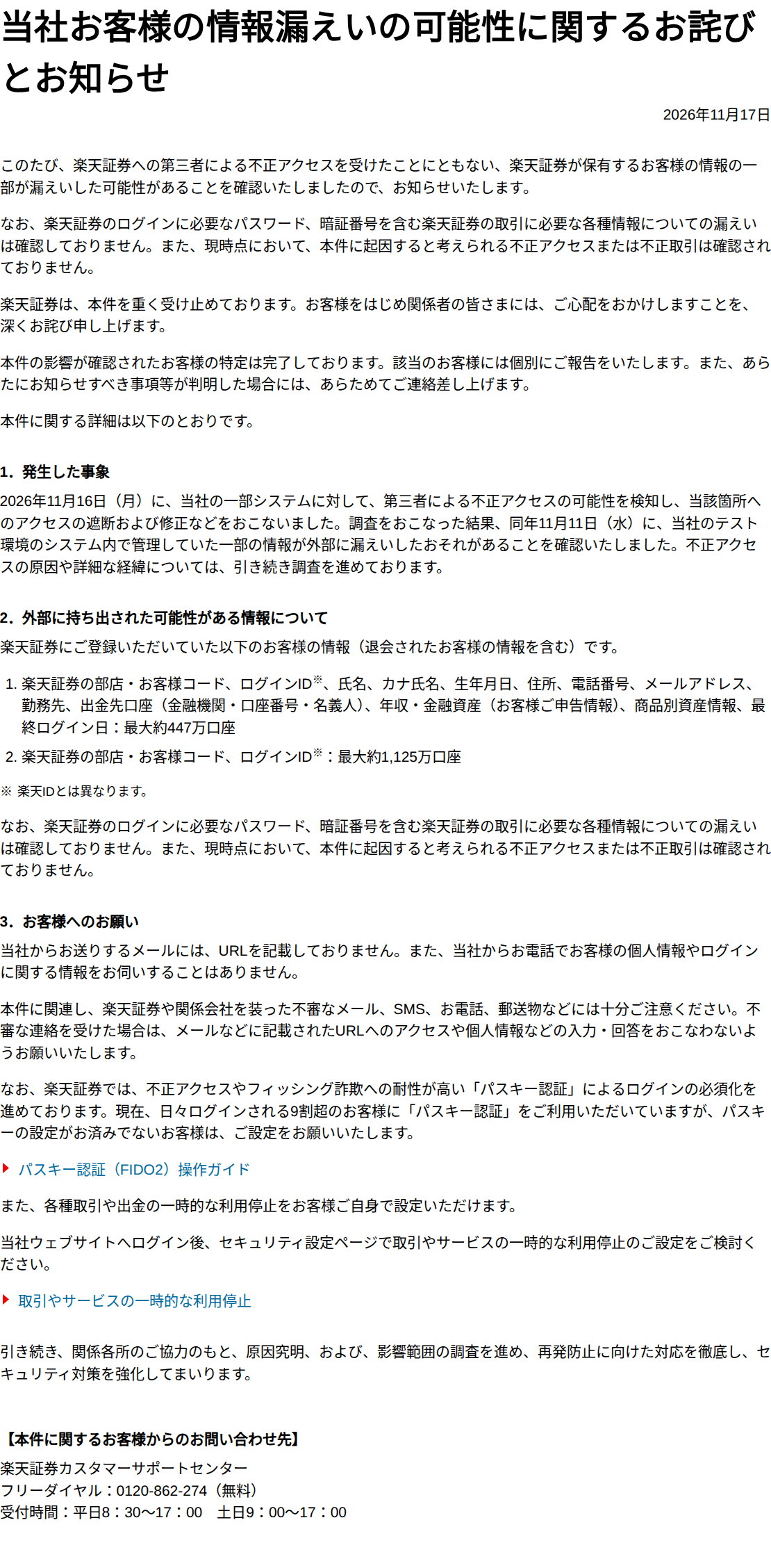
On 17 November 2026, Rakuten Securities, an online broker, said customer information held in a test environment system may have leaked after unauthorised access by a third party. The possible exposure reaches two tiers. For up to about 4.47 million accounts, the data that may have leaked includes email addresses, declared income and withdrawal bank details. Login IDs for up to about 11.25 million accounts may also have leaked. None of this is confirmed. Every figure in the company's notice is stated as up to and may have been leaked.
Disclosure and timeline#
The notice, titled "Apology and Notice Regarding Possible Leakage of Customer Information", went out on 17 November 2026. In it, the company said possible unauthorised access to part of its systems came to light on 16 November. Access was cut off. Checks after that pointed to information in a test environment system that may have leaked on 11 November. What caused the incident, and how the attacker reached the test environment, remain under investigation. The notice gives no answer to either question. It also leaves two others unanswered: why customer data sat in a test environment system at all, and why five days passed between the possible leak on 11 November and its discovery on 16 November.
Rakuten Securities published its notice on 17 November. NHK WORLD reported the disclosure the same day, with Jiji Press and Reuters covering it on 17 November as well. NHK reported that Rakuten Securities held more than 15 million customer accounts as of 2 November 2026. A total of about 15.72 million accounts is the figure Jiji Press headlined, a number reached by adding the two figures in the notice, 11.25 million and 4.47 million. The addition double counts, because accounts in the smaller tier also carry the branch code, customer code and login ID of the larger tier. The two figures describe different data items for overlapping accounts, so they cannot simply be added together.
What data may have leaked#
Two tiers of exposure appear in the notice. The first covers up to about 11.25 million accounts. For those accounts, the data that may have been taken stops at the branch code, the customer code and the login ID. The company said the login ID is separate from the Rakuten ID used across Rakuten Group services. The second tier covers up to about 4.47 million accounts, former customers who closed their accounts included. For those accounts, the data that may have been taken runs far wider, and the full list is quoted in Cybersixt's report on the disclosure.
| Data item | First tier (up to 11.25m accounts) | Second tier (up to 4.47m accounts) |
|---|---|---|
| Branch code and customer code | Yes | Yes |
| Login ID | Yes | Yes |
| Name in kanji and kana | No | Yes |
| Date of birth | No | Yes |
| Address | No | Yes |
| Phone number | No | Yes |
| Email address | No | Yes |
| Employer | No | Yes |
| Bank account registered for withdrawals (bank, account number and holder) | No | Yes |
| Declared annual income and financial assets | No | Yes |
| Holdings by product | No | Yes |
| Date of last login | No | Yes |
Taken together, the second tier amounts to a near complete profile of an investor. It holds identity, contact details, employer, the bank account used for withdrawals, declared income and assets, and holdings by product. The email address in that set is the item that opens the next stage of the attack. A message sent to a verified address tied to a named person, a known broker, a known bank and a known income band is harder to dismiss than a generic message. Rakuten Securities warned customers about fake contact claiming to come from the broker. Cybersixt, reporting the notice, puts the warning this way:
"Rakuten Securities says its emails contain no links and that it never asks for personal or login details by phone."
That warning is in the notice itself. What did not leak, as far as the company has confirmed, is the information needed to trade: Rakuten Securities said it has not confirmed any leak of login passwords, PINs or other information needed to execute trades. It has found no unauthorised logins or trades linked to the incident so far. That position is the company's own statement as of 17 November, and it may change as the investigation continues.
Why the leaked email addresses matter#
One address given to one service and reused across many services cannot be traced to a single source when it turns up in a breach file. An address given only to Rakuten Securities can be traced to Rakuten Securities. No other service holds that address. AliasFleet provides one dedicated email alias per service. Each alias forwards to the user's inbox, and the address handed to a service is unique to that service. When an alias appears in a leaked file, the user can close that alias, while the primary inbox address and the aliases used for other services stay the same.
The alias does not prevent a company from holding customer data, and it does not stop phishing messages sent to an address already given out. It limits the damage to one service, because the exposed address belongs to that service alone and can be closed in one step.
Apology, customer contact and passkey requirement#
Rakuten Securities apologised for the concern caused to those affected. It said it has identified the affected customers. Each of them will be contacted individually. The company said it will keep investigating the cause of the incident and the scope of its impact. It will put measures in place to prevent a recurrence and strengthen its security safeguards.
The company also moved to push customers toward passkey login. Passkey authentication is being made mandatory. More than 90 percent of customers who log in each day already use one, the company said. Passkey login uses fingerprint, facial recognition or another device based check instead of a typed password, so a leaked login ID alone does not open the account. Customers who have not set up a passkey are asked to do so, and they can also temporarily block trading and withdrawals themselves from the security settings page after logging in. Daiwa Securities disclosed a separate breach in October 2026, in which about 110,000 clients' names, email addresses and account numbers were exposed through a vendor's hacked inquiry server, with a different entry point and a far smaller possible scope.
Customer guidance in the notice#
Rakuten Securities set out several measures for customers in its notice. Any email, SMS, call or letter claiming to come from Rakuten Securities or its group companies should be treated as suspect. The company said its emails contain no URLs. It never asks for personal or login details by phone. Links in unexpected messages should not be clicked. Personal details should not be given over the phone to an unexpected caller. Customers who have not set up passkey login should do so. The company is making it mandatory. A login ID on its own is not enough to enter an account once a passkey is in place. Customers who want a stronger stop can temporarily block trading and withdrawals from the security settings page after logging in. The company offers that as a self service option.
The email address itself needs attention beyond this one incident, because an address that appears in a breach file can be reused for phishing for years, and the address in this file is tied to a known broker and a known income band. Checking whether an address appears in known breaches is the first step. The address should be treated as exposed, even while Rakuten Securities has not confirmed the leak. How credential stuffing works explains why a leaked login ID still matters without the password, because the same ID and password combinations get tried across other services. How an exposed email address leads to identity theft sets out the longer chain, from a single leaked address to account takeover attempts elsewhere. What to do when your email is in a data breach sets out the steps in order. How phishing uses your leaked email explains the messages to expect next.
Your address is probably in this file. Check whether it is, do the checks and passkey setup above, and then fix the part you control: the address you hand out next time. One AliasFleet alias per service means the next leak can only point back to the service that leaked it. Founders Club is $7 a month, locked forever, instead of $12. Early members only.
Open questions and regulator reporting#
The investigation is still open. The company has not named an attacker, a method of entry, or a reason why production customer data was held in a test environment. It has not confirmed whether any data actually left its systems, only that it may have leaked. It has not said whether the incident has been reported to Japan's Personal Information Protection Commission or the Financial Services Agency, and no regulator statement has been reported. The figures may also change. The notice gives ceilings, up to about 11.25 million accounts for login IDs and up to about 4.47 million for the full personal and financial set, and the company has said it will contact affected customers individually once it has confirmed who they are. Until the investigation reports, the position is the company's own: a possible leak, unconfirmed, with no passwords or trading credentials confirmed exposed and no unauthorised trades found so far.
