
GoFundMe confirmed on 20 November 2026 that a data breach at GoFundMe Pro exposed donor and supporter names, postal addresses, email addresses, phone numbers and dates of birth for some donors. An unauthorised third party accessed the data through the GoFundMe Pro API in two periods, 10 to 18 October and 8 to 9 November 2026. The incident affected GoFundMe Pro, the fundraising platform for nonprofit organisations formerly known as Classy, and not personal GoFundMe fundraisers. No victim count has been disclosed.
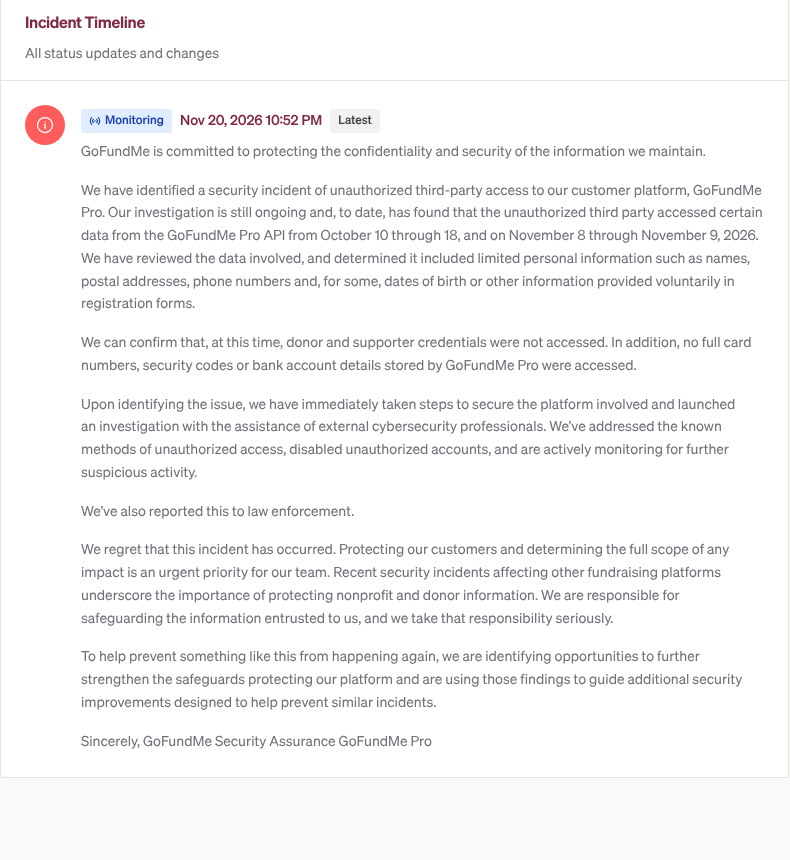
GoFundMe published its security notice on 20 November, the day after notifications to affected individuals began. The notice stated that donor and supporter credentials were not accessed and that no full card numbers, security codes or bank account details stored by GoFundMe Pro were accessed.
The access windows#
The notice stated that the investigation was ongoing and had found unauthorised access to certain data from the GoFundMe Pro API from 10 through 18 October and on 8 through 9 November 2026. GoFundMe said it had addressed the known methods of unauthorised access, disabled unauthorised accounts and was monitoring for further suspicious activity. The company reported the incident to law enforcement and engaged external cybersecurity professionals. Updates appeared on GoFundMe's status page while the investigation continued.
Donor data exposed#
The public notice listed names, postal addresses, phone numbers and, for some people, dates of birth or other information provided voluntarily in registration forms. It did not list email addresses. Fortune reported on 21 November that GoFundMe's notification to affected customers did include email addresses, and that for some organisations the attacker also obtained credentials for GoFundMe Pro's Salesforce integration. Cybernews confirmed the same dates and data types on 23 November and noted that no victim count had been revealed.
A name, a postal address, a phone number and a date of birth together form a workable identity profile, and an email address tied to a known donation gives a phishing message a credible opening line. The absence of card details does not reduce that phishing exposure.
No list of affected nonprofits has been published: GoFundMe's notices name GoFundMe Pro only, so individual donors depend on the notification email to learn whether they were affected. Notifications began by email on 19 November 2026, mailed notices went to people in North Dakota and Washington, and a dedicated call centre opened the same day.
Email aliases and donor exposure#
A donor who gives through a fundraising platform hands over a name, a postal address, a phone number and an email address so the charity can process a gift and send a receipt. That data then sits in the fundraising platform, in the organisation's customer relationship system and in the integration between them. An email alias changes only the email part of that exposure: a name, a phone number and a postal address given at donation remain exposed whatever address was used.
The mechanism is straightforward. A different email address for every website means a donation made with a dedicated alias exposes only that alias if the platform is breached. The alias points back to the service that leaked it, and the donor can close that one address without changing a primary inbox. AliasFleet provides one managed alias per service on that model, each kept as a persistent forwarding identity under the user's control. The alias does not recover data already given or stop phishing that quotes a name and a donation history. It limits the next leak to a single address that can be traced to its source and closed.
The Salesforce integration#
The Salesforce connection is the second part of the incident. GoFundMe Pro connects to Salesforce for many nonprofits. The integration syncs donor and supporter records into the organisation's customer relationship system. GoFundMe told customers that the attacker "accessed credentials associated with the GoFundMe Pro Salesforce integration, which they may have used to access those organizations' records in Salesforce," as quoted by the Chronicle of Philanthropy. GoFundMe has not confirmed that any organisation's Salesforce records were actually accessed, and no organisation has confirmed such access publicly.
Salesforce gave its own account to The NonProfit Times. The company said it "disabled the GoFundMe Pro connected app and associated managed packages as a precaution after identifying suspicious use of access tokens associated with the third-party provider." Salesforce added that the issue "did not arise from a vulnerability within the core Salesforce platform" and that the integrations remain unavailable until the necessary security remediation is complete and GoFundMe has demonstrated that they can be safely restored.
Salesforce issued specific guidance for users of the GoFundMe Pro integration: rotate all keys and credentials stored in a Salesforce environment, review the Setup Audit Trail and Login History for unfamiliar activity since 14 October, review users created or modified since that date, and review Apex execution and API activity. The 14 October review date starts four days after the first access window opened on 10 October.
DonorPerfect and the wider pattern#
GoFundMe Pro was not the only nonprofit fundraising platform hit that week. DonorPerfect, a separate fundraising platform serving about 11,000 nonprofit customers, took its platform offline on the evening of 10 November 2026 after attacks were attempted on its systems. Its president, Lauren Sheehan, told the Chronicle of Philanthropy that the company had confirmed unauthorised activity and engaged cybersecurity experts. Users began regaining access in stages from 14 November, and by the afternoon of 16 November 99 percent of systems had been restored, though the API remained offline. The FBI is aware of the DonorPerfect incident, according to the Chronicle of Philanthropy.
Sheehan attributed the DonorPerfect attack to AI bots, saying the company had evidence the attacks were run by AI agents that rapidly adapted their approaches. That claim belongs to DonorPerfect and has not been independently confirmed, and it has not been presented as the method used against GoFundMe Pro. DonorPerfect also said it had not yet determined whether customer information was accessed. Whether the same actor is behind both incidents remains unconfirmed.
| Detail | GoFundMe Pro | DonorPerfect |
|---|---|---|
| Disclosure | Security notice, 20 November 2026 | Platform taken offline, evening of 10 November 2026 |
| Access period | 10 to 18 October and 8 to 9 November 2026 | Not disclosed |
| Donor data exposed | Names, addresses, email addresses, phone numbers, some dates of birth | Not yet determined |
| Platform status | Salesforce integration unavailable until remediation is complete | 99 percent of systems restored by 16 November; API offline |
GoFundMe said there was strong reason to believe bad actors were making similar attempts to access other fundraising platforms. That is the company's assessment, not a confirmed campaign, and neither company has attributed the incidents to the same actor.
Giving Tuesday timing#
Giving Tuesday falls on 1 December 2026, the peak day of the nonprofit fundraising calendar. GivingTuesday.org lists 1 December 2026 as the date. The GoFundMe Pro notice went public eleven days before that date, and notifications to affected individuals began twelve days before it.
Giving Tuesday is also one of the heaviest email periods of the nonprofit calendar. Charities send appeal after appeal and donors expect fundraising mail, so the volume makes a convincing fake harder to spot. A donor who gave through a nonprofit using GoFundMe Pro has a name, an email address and a donation history that an attacker can quote back at them. The most likely near-term misuse is phishing: a message that names the charity, references a real donation, and asks the donor to confirm payment details or click through to a fake donation page. Donors should treat unexpected fundraising mail with more care than usual before 1 December, and nonprofits should expect supporters to ask whether a message is genuine.
Measures for affected donors#
A notification from GoFundMe Pro means the donor's data was exposed. The donor should treat name, email address, postal address, phone number and date of birth as exposed. The first step is to check whether the address is already known to have appeared in a breach, using Have I Been Pwned. A listing confirms the address has circulated; the absence of a listing does not prove it safe, because GoFundMe has not published a victim list.
A message that names a real charity and references a real donation is not proof that the sender is that charity. Donors should reach the charity through its own website before acting on any payment request. Payment details should not be entered through a link in an unexpected fundraising message.
Password reuse is the main risk after an email address is exposed. A leaked email address lets an attacker try credential stuffing where the same address and a reused password might work, and a date of birth adds a common security-question answer to the same profile. A guide on whether someone can hack an email account using a date of birth sets out what a date of birth does and does not allow an attacker to do. Donors should change reused passwords and enable two-factor authentication on email and financial accounts.
Nonprofits using GoFundMe Pro should follow the Salesforce guidance above: rotate keys and credentials, review account activity since 14 October, and check for users created or modified since that date. They should also tell their supporters, in their own words, what happened and what to watch for, since GoFundMe's notices do not name the affected organisations.
Your address is probably in this file. Check whether it is, do the password work above, and then fix the part you control: the address you hand out next time. One AliasFleet alias per service means the next leak can only point back to the service that leaked it. Founders Club is $7 a month, locked forever, instead of $12. Early members only.
Gaps in the disclosure#
GoFundMe's investigation is ongoing. The company has not said how the third party obtained access to the API, how many donors, supporters or nonprofits were affected, or whether the Salesforce credentials were actually used to access any organisation's records, only that they may have been. It has not said whether the exposed data has appeared for sale or distribution, and it is unknown whether the stolen data has been exploited, as Cybernews reported.
Donors give a charity their name, address, email and phone number because the charity needs them to process a gift and send a receipt. That data then sits in three places: the fundraising platform, the customer relationship system and the integration between them. A breach of any one of those stores exposes the donor to phishing from someone who knows which cause they support.
