
The Coinone data breach exposed customer support records held by MetaM, the outsourced provider that runs the South Korean crypto exchange's support. Coinone disclosed the incident on 15 November 2026, three days after an attacker accessed MetaM's servers at about 04:00 KST on 12 November. The records may include names, email addresses, passwords, resident registration numbers, bank account numbers and crypto wallet addresses. Only customers who contacted Coinone support are affected, and Coinone has disclosed no victim count.
The intrusion and the disclosure#
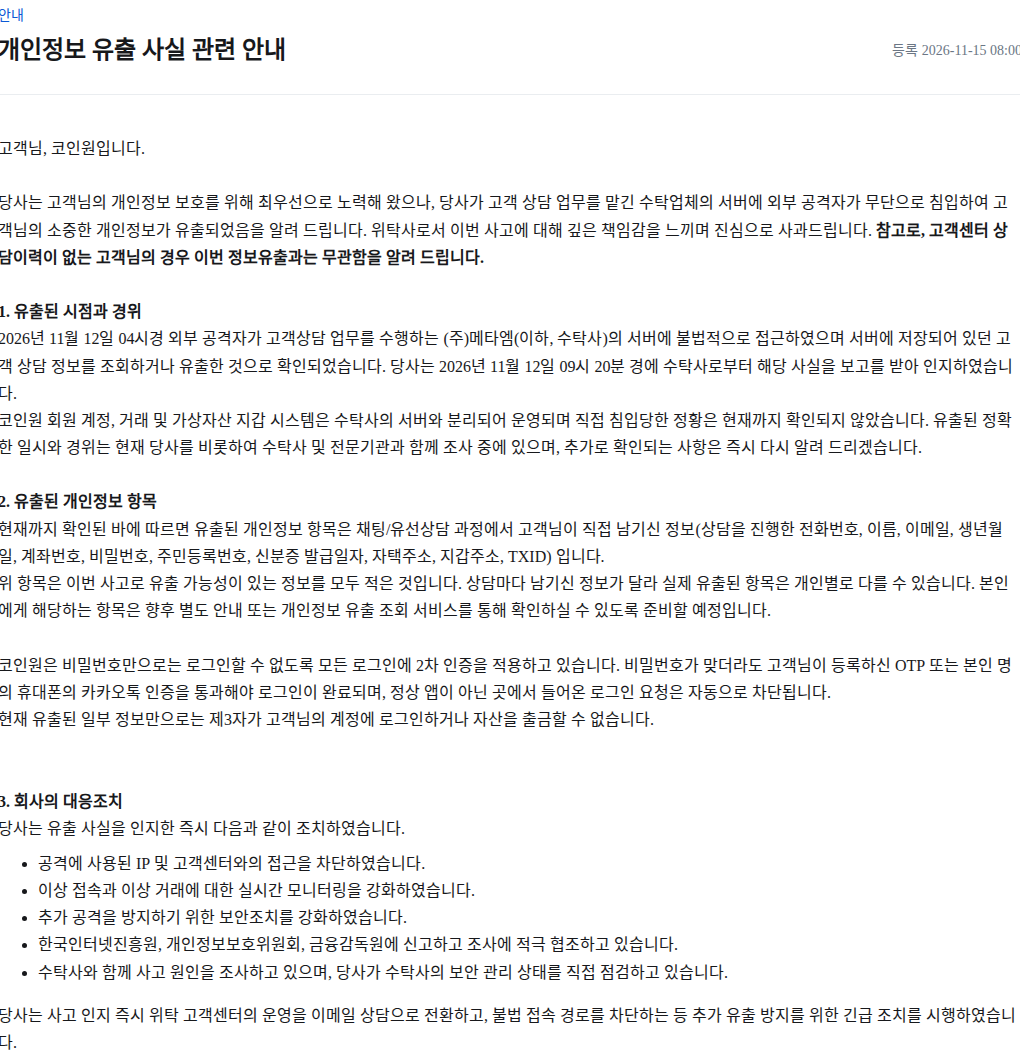
Coinone posted its official notice, "개인정보 유출 사실 관련 안내" (Notice on personal information leak), at 08:00 KST on Sunday 15 November 2026. The notice states that an external attacker accessed MetaM's servers at about 04:00 KST on Thursday 12 November, and viewed or extracted the customer support information stored there. MetaM reported the incident to Coinone at about 09:20 KST the same day. The Coinone notice is the primary source for the intrusion time, data list and scope.
MetaM posted its own notice a day earlier, on 14 November. According to Yonhap reporting, MetaM spotted suspicious activity after a support-service outage at 06:03 on 12 November, and reported the incident to the Korea Internet and Security Agency (KISA) at 03:44 on 13 November. MetaM isolated the affected servers, blocked suspicious IP addresses and brought in security specialists. The Herald Business and Gadgets360 reports both carry the MetaM timeline and the 11-field data list.
Coinone dates the intrusion to about 04:00, while MetaM's account starts with the 06:03 outage, so the two accounts do not line up exactly. Coinone states that the exact timing and route are still being investigated with the vendor and outside specialists.
The public notice came about 70 hours 40 minutes after Coinone learned of the incident. Under article 39 of the enforcement decree of South Korea's Personal Information Protection Act, a company must notify affected people within 72 hours of learning of a leak. Alphabiz reported the gap and the 72-hour rule, so the notice fell inside the legal window.
Support records exposed#
The exposed records are information customers gave during chat and phone support sessions. Coinone's notice lists 11 fields that may have been exposed: phone number used for the consultation, name, email address, date of birth, bank account number, password, resident registration number, ID document issue date, home address, wallet address and transaction ID (TXID).
The notice is explicit that this list covers everything that could have been exposed, not what was exposed for any one customer; support conversations differ, so the actual items vary by person. A lookup service and individual notices are planned.
A resident registration number is Korea's national ID number and cannot be changed the way a password can; the ID document issue date is also a fixed identity anchor. Combined with a name, date of birth and home address, those fields are the material Coinone warned could be used for identity theft, while the bank account number and wallet address add direct financial value.
The password field stands out because some customers gave support their password during an interaction, and that password was stored in the support record. Coinone's notice does not say whether its agents asked for passwords or customers offered them. Cointelegraph reported the disclosure and the phishing and identity theft warning that followed it.
Whether the data was only viewed or actually taken out is not settled; Coinone's wording covers both, and neither company has confirmed exfiltration.
Customers affected#
Only customers who contacted Coinone's support centre are affected. Coinone has not said how many did so or what date range the records cover, so the number affected is unknown.
Coinone states that its account, trading and wallet systems run separately from MetaM's servers, with no direct intrusion confirmed, and that the leaked partial information alone is not enough for a third party to log in or withdraw assets, because all logins use two-factor authentication. No customer funds have been reported lost.
Coinone response and support changes#
Coinone reported the incident to three authorities: the Korea Internet and Security Agency, the Personal Information Protection Commission and the Financial Supervisory Service. The company says it blocked the IP addresses used in the attack and the access route to the customer centre, strengthened real-time monitoring of abnormal logins and transactions, and moved outsourced support to email only while the investigation continues. It is also reviewing MetaM's security management with the vendor. The notice also sets out the compensation route under Korean law: customers who suffer harm can claim damages, up to five times the loss where the company was grossly negligent, or statutory damages of up to 3 million KRW where the amount of harm is hard to prove.
Regulatory context#
Cointelegraph reported that the Financial Services Commission found security deficiencies at 130 of 555 financial firms it reviewed in October 2026, and that the regulator would allow crypto exchanges to suspend withdrawals when a hack is suspected.
The Coinone incident is also the third security scare at a Korean exchange in under three weeks, according to Coindaro, after Bithumb on 27 October and Gopax on 6 November; Coinone's own notice does not confirm that context.
Steps for affected Coinone customers#
Customers who gave a password during a support interaction should change it, and change the same password anywhere else it is used. They can also lock their account from the same menu and should check their registered withdrawal addresses.
Customers should also watch for login, order or withdrawal attempts they did not make and report them to Coinone's service operations team.
Coinone states in its notice that it never asks for passwords, OTP numbers or authentication codes by phone, text or email, and never asks for crypto withdrawals or wallet address changes. Any message making such a request does not come from Coinone.
The same applies to messages quoting details from an earlier support conversation: that detail is now in attacker hands, so it no longer proves the sender is genuine.
The leaked email addresses change the phishing risk. An attacker who knows a customer's name, email address and support case details can write a message that reads like a real follow-up from Coinone. Customers should check the sender address rather than trusting the display name, and reach the exchange through its own site or app rather than a link in an email. How phishing uses a leaked email explains the pattern in detail, and what to do when your email is in a data breach covers the wider steps.
If you contacted Coinone support, your address may be in this file. Check whether it is, do the password work above, and then fix the part you control: the address you hand out next time. One AliasFleet alias per service means the next leak can only point back to the service that leaked it. Founders Club is $7 a month, locked forever, instead of $12. Early members only.
The support-chat pattern#
The Coinone breach is a vendor breach, and the vendor held a type of data that gets less attention than customer databases. Support records sit in a different system, run by a different company, and hold whatever customers typed or said while solving a problem, including passwords, account numbers and ID numbers.
Daiwa Securities and Citizen Watch both lost customer data through Scala Communications, a vendor that ran their inquiry servers, and Sompo Japan lost records through the same vendor. In each case the outsourced provider, not the company's own systems, was the entry point.
Coinone's case adds one detail: the data was not collected by a form or a system but volunteered in conversation. A customer who tells a support agent a password to speed up a fix has put that password into a record the customer never sees again.
An alias limits the damage from the email field in a support record. If a customer contacts support from the alias used for that service, the exposed address is the alias, not the customer's real inbox, and the next leak can be traced to the service that leaked it. The alias does not protect the other fields: the password, ID number, bank account number and wallet address were given in the same conversation and are exposed regardless of the email address used. The password and ID fields need their own protection: unique passwords per service, and no ID number given to a support agent unless the service genuinely needs it.
Questions without answers yet#
No victim count has been disclosed, and no date has been given for the lookup service or the individual notices. The exact intrusion route is under investigation, and the first intrusion time differs between Coinone's 04:00 account and MetaM's 06:03 outage. MetaM serves other companies and named no other client, so whether other firms' records were also exposed is unknown. No attacker attribution, ransom claim or sale of the data has been reported.
