
Bell Canada, one of Canada's largest telecommunications providers, confirmed that an unknown party gained unauthorised access to an internal system on 17 November 2026. Customer personal information that may have been accessed includes names, email addresses, account numbers and the date and amount of customers' last payment. The incident affected residential and business customers across five brands: Bell, Bell Aliant, Bell MTS, Virgin Plus and Lucky Mobile. A separate enterprise system used to order and provision telecommunications circuits was also accessed, and Bell described the attacker as an "agentic threat actor" without identifying who was responsible.
How Bell disclosed the breach#
Bell disclosed the incident in two stages over the six days that followed. On 20 November, BleepingComputer reported that Bell had confirmed an intrusion affecting enterprise customer data. The publication had received a tip from a customer who shared a breach notification sent by Bell's own information security team.
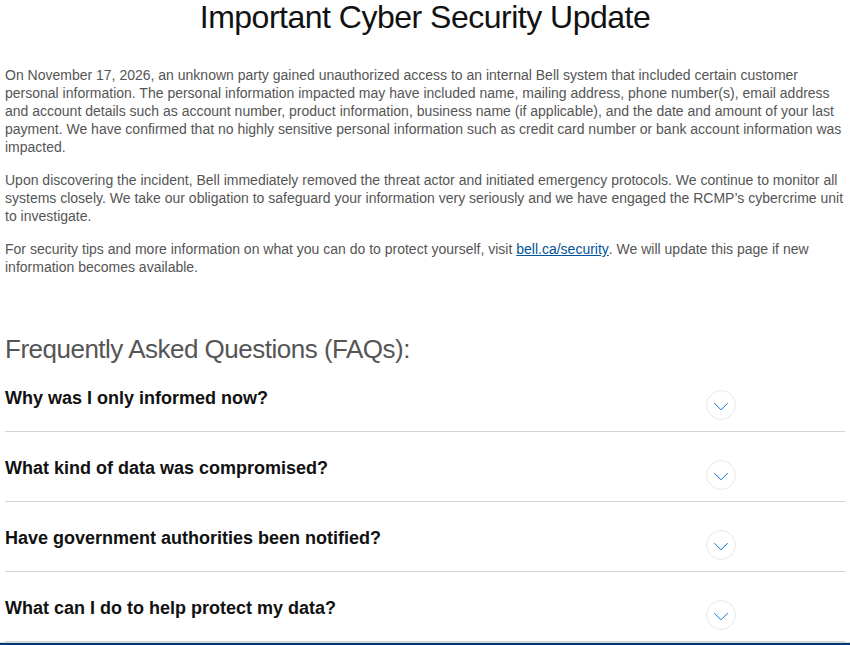
On 23 November, Bell published a notice on its website and emailed residential and business customers. The Canadian Press reported the customer notice the same day. Bell's website notice states: "On November 17, 2026, an unknown party gained unauthorized access to an internal Bell system that included certain customer personal information."
Bell has not published a single consolidated notice tying every detail together, so the two facets are described separately below, each attributed to its source.
Enterprise data in the Maximo system#
The enterprise facet concerns a pre-production environment of Bell's Maximo system, used to order and provision telecommunications circuits. Bell's statement to BleepingComputer reads: "Bell is investigating a cybersecurity incident that occurred on November 17 in which an agentic threat actor accessed some of our systems, including a system used for ordering and provisioning circuits, and exfiltrated some enterprise customer data."
The potentially exposed enterprise data includes business contact information: names, job titles, corporate email addresses, phone numbers and business addresses. It also includes information contained in ticket titles, some IP addresses associated with network elements or systems, and limited contextual information. Bell's customer notification states that information belonging to the recipient's organisation may have been stolen.
Bell set out what the affected dataset did not contain. It did not contain credentials, highly sensitive personal information, PDFs, file attachments, or any other supplementary information stored in the Maximo system. Bell has not disclosed how many enterprise customers were affected or the total amount of data taken.
Residential and business customer data#
The residential facet concerns an internal Bell system that held customer personal information. Bell's website notice lists the data that may have been accessed:
| Data type | Detail in Bell's notice |
|---|---|
| Name | Customer name |
| Mailing address | Customer mailing address |
| Phone number | Phone number or numbers |
| Email address | Customer email address |
| Account number | Customer account number |
| Product information | Products held with Bell |
| Business name | Business name, where applicable |
| Last payment | Date and amount of the customer's last payment |
Bell confirmed that no highly sensitive personal information such as credit card numbers or bank account information was impacted in this part of the incident, and has not disclosed how many residential or business customers were affected.
Bell spokesperson Ellen Murphy named the five affected brands, as reported by The Canadian Press: Bell, Bell Aliant, Bell MTS, Virgin Plus and Lucky Mobile.
The fields in the residential facet are the material used in impersonation messages: a real name, account number and last payment amount make a message that claims to come from Bell harder to dismiss, and the email address is the channel it arrives through. An email address exposed without a password still leaves its owner exposed to targeted phishing. The address itself identifies the account and the person behind it.
The "agentic" description#
Bell's description of the attacker as an "agentic threat actor" is the most unusual detail of the incident, and it needs careful handling. BleepingComputer reported that the description suggests AI-powered tools were used during the breach. That reading is BleepingComputer's interpretation, not Bell's statement. Bell has not explained what it means by "agentic", which tools the attacker used, or the intrusion method.
Bell also said it does not know who carried out the attack. "We currently do not know the attribution," Bell told BleepingComputer. No threat actor has been named in any of the sources read for this article, and no group has publicly claimed responsibility in those sources. Until Bell says more, the "agentic" wording is a label the company chose, not a confirmed description of how the attack worked.
Measures published for customers#
Bell published advice for customers in its website notice and in its customer email. The company advises customers to remain wary of unsolicited requests from people posing as Bell, especially requests for personal information or directions to a website to enter it. Customers should avoid clicking links or downloading attachments from suspicious emails or text messages, and should regularly review their accounts for suspicious activity. Bell points customers to bell.ca/security for security tips.
Bell states it will never contact customers to ask for bank account information, passwords or PINs. Any contact that asks for those details is not from Bell.
Bell has not said whether passwords were involved in the residential incident, and the company's advice does not include a password change. The distinction between an exposed email address and an exposed password matters for what a customer does next. Changing a password stops further access only where the password itself was the weakness, and it does nothing about the exposed contact details, which cannot be changed in the same way. Customers who reused their Bell password on other services should change it on those services, and a unique Bell password faces a smaller risk. Customers can check whether their email address appears in known breach records to establish whether this incident is the first time it has appeared in a leak. Have I Been Pwned is one service that runs such a check.
AliasFleet and the Bell records#
AliasFleet provides one forwarding email alias per service, so the address a customer registers with Bell is used only for Bell and forwards to a single inbox. When the Bell address appears in a leak, the leak points back to Bell alone. The address can be closed without changing the address used anywhere else. Using a different email address for every website describes the approach in detail, and what an email alias is sets out how forwarding aliases work.
An alias does not prevent a provider's systems from being accessed, and it does not recover data that has already been exposed. The Bell records already given to Bell cannot be taken back. The name, mailing address, phone number and account number in those records remain exposed regardless of which email address was used. What the alias changes is the next leak: an address used only for Bell cannot be matched against leaks from other services to build a fuller profile of the same person.
Your address is probably in this file. Check whether it is, do the password work above, and then fix the part you control: the address you hand out next time. One AliasFleet alias per service means the next leak can only point back to the service that leaked it. Founders Club is $7 a month, locked forever, instead of $12. Early members only.
Investigation status and undisclosed facts#
Bell says it immediately contained the incident and secured its systems, and that there has been no impact to customer services. The company says it immediately removed the threat actor and initiated emergency protocols, and continues to monitor all systems closely. Bell has engaged the RCMP cybercrime unit to investigate, and says it will advise other regulatory authorities in accordance with applicable requirements. Bell has set up a web page where it says it will provide updates on key developments.
Bell told BleepingComputer it is sharing indicators of compromise and threat-hunting information with enterprise customers and the Canadian Centre for Cyber Security. The indicators have not been publicly released, and Bell did not respond to BleepingComputer's request to share them so other organisations can check their environments for related activity.
Several facts remain undisclosed. Bell has not given a victim count for either facet of the incident, has not disclosed the total amount of data stolen, has not described the intrusion method beyond the "agentic threat actor" wording, and has not identified the attacker. Bell has not said whether the exposed data has been misused, and the absence of a statement on misuse is not a statement that misuse has not happened.
The incident also fits a wider pattern in Canadian telecommunications in 2026. MobileSyrup reported that Telus suffered a breach between February 2025 and June 2026, Cogeco's Oxio suffered a breach, as did Rogers and Fido, and Freedom Mobile suffered a breach in January. Bell is the latest carrier on that list. That pattern is verified only from MobileSyrup's 23 November summary, not from primary incident reports for each carrier. The investigation is ongoing, and Bell's updates page is where new facts will appear first: a victim count, the intrusion method and any statement on misuse would be published there if Bell releases them.
